Book Reviews
BlueInk Reviews

BlueInk Review
This Wild West saga follows the life of a young man who leaves home to fight in the Civil War, then survives myriad trials to become a successful rancher and proud family man.
In the prologue, Linda Riddle describes how her husband Ted woke up at 4 a.m. one Sunday morning and began speaking in a different voice and dialect. “The hairs on my arms stood on end and chills continued as he told in detail events that happened over one hundred years ago.” These recollections form the basis of the story.
In 1862, Tom Summers is 16 years old when he and his brother, John, leave their Tennessee home to join the 34th Illinois Infantry. The brothers are soon separated, and Tom is wounded and in danger of losing a leg. A kind nurse helps him recover, and Tom, having seen enough violence, deserts, heading west, where he’s told he’ll find neutral Indian territory 300 to 400 miles away.
Dodging military scouts in search of deserters and backwoods thieves, surviving snake bites and experiencing his first time with a woman, Summers reaches Camp Supply, Oklahoma, where he finds work as a blacksmith and begins learning skills to survive in the west. He establishes a ranch; marries and has children; faces all manner of unsavory characters, including a murderous banker; leads adventuresome cattle drives, and occasionally takes the law into his own hands.
This is an engaging read, rich in historical detail, color and description (“All Tom heard was a whizzing sound, and Jimmy’s head was gone,” the authors write of wartime.) The pacing is varied, with plenty of action and drama throughout, but slowing when the narrative veers into descriptions of family life, such as planning a wedding, furnishing a home, etc.
The use of dialect, with words such as “goin’, lookin’, killin’ lettin’,” grows tiresome, and the tale is not necessarily fresh. Nonetheless, it’s an absorbing escape that Western fans will enjoy.
Foreword Reviews

Foreword Reviews
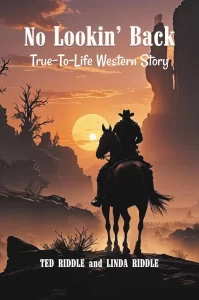
Ted Riddle and Linda Riddle’s historical novel No Lookin’ Back recounts frontier adventures in the 1800s American West.
A dream-inspired, transcribed story embellished with details gleaned from research, library visits, and travels, the tale follows Thomas and John Summers, brothers who join the Union Army, fight in the Civil War, and then go out to explore the Wild West. They visit Arkansas, Oklahoma, Texas, Kansas, and Colorado during their wide-ranging travels, which are an open-ended look at their historical period.
The story “ends and begins” with a gripping account of Thomas’s death. This carries greater symbolic weight: the event represents a transition from an old, established way of life to the barreling progress of the modern world. Jumping back in time to his birth in Tennessee, the book then shares riveting, episodic tales that reinforce its theme of boundless horizons to explore. Thomas’s trips through Oklahoma territory, Texas cattle drives, and the Rocky Mountains capture the expansive sweep of the West and evoke the sparse grandeur of its rugged landscapes. Later, a heartbreaking loss leads to a ride-off-into-the-sunset conclusion alluded to early on. It’s a poignant, contented ending that also reflects some personal growth.
Embellished by supplementary materials (including a timeline of Western history, drawings, black-and-white photographs, and pencil illustrations that become more elaborate as the story goes on), this is an atmospheric tale. The book touches upon familiar historical reference points, too, including Wyatt Earp, Dodge City, and General Custer, weaving edifying factual information in. There are telling details about chuck wagons, hardtack, and bronco busting that animate its backdrop. Though its conversations are too exclamatory, its prose is otherwise straightforward and clear, complementing the shifting settings. When a train passenger falls and breaks his neck, for example, others open “the baggage-car door and [throw] the dead man in, right beside Tom’s saddles and belongings.” Grit and guilelessness dominate, as do memorable phrases (his “head felt as big as a number 3 washtub”). Grounded in the plainspoken dialect of its era, the prose evokes much with a few deft strokes: the “trains heading west were full of hopefuls chasing a dream” and the “sunsets were spectacular, showing the reds and golds in the whirls of clouds.”
The rollicking historical novel No Lookin’ Back captures the spirit of the Wild West via two brothers and their unquenchable sense of adventure.
Hollywood Book Reviews

HollyWood Book Reviews
Co-authors Ted Riddle and Linda Riddle pack a punch with their stirring novel, No Lookin’ Back: True-To-Life Western Story which forms a unique tapestry of events. Through the main character, Thomas Jefferson Summers, the book explores the American Old West in the 1800s. A striking foreword offered by Linda forms the basis of the story detailing how her husband, Ted, woke up one Sunday morning speaking in a different tone and strange dialect and both realized that the chronicle had to be published.
Thomas and his brother John lived with their parents in Tennessee and had grown up being the objects of their father’s drunken and violent fits. The two join the Union army, partly to escape this, and get separated shortly after recruitment. The story puts Tom on center stage and readers move with him as he encounters numerous challenges; he narrowly escapes a leg amputation by a brutal field doctor, he is forced to venture into the uncertain Cherokee nation as he makes his way up north, evade soldiers looking for deserters like Tom, encountering dangerous snakes in the rustic wild and persevering hard rain. Eventually, he becomes a wealthy rancher and patriarch.
This was such a riveting story which carried me through various states such as: Arkansas, Colorado, Oklahoma, Texas, and Kansas. Told with verve, the story is enhanced with information obtained via travels, libraries, and study, digging deep into the American folk lore. This lets you feel and imagine the expansive landscapes of America and the epic events which changed the continent – and in retrospect, greatly influenced the development of the United States.
No Lookin’ Back: a True-To-Life Western Story by Ted Riddle and Linda Riddle is an adventure waiting to unravel. Connoisseurs of historical fiction will find this enlightening and absorbing Wild West saga worth poring over.
Kirkus Reviews

A Southerner joins the Union Army and ends up forging a new life in the West in this sprawling novel from a husband-and-wife team.
As the story opens, Thomas Jefferson Summers is facing the end of his life at the age of 60. The totality of that life unfolds as the book flashes back to 1862, when Tom, 16, and his brother, John Adams Summers, 19, set off to fight for the Union Army during the Civil War. Tom is soon injured and deserts his post to head back home (“He had seen all of the war that he wanted to see”). Tragically, he finds that his parents have died and his Tennessee town has burned to the ground. And that’s just in the first 30 pages, with the rest of the narrative following Tom as he heads west, settles down, starts a family, and forges a new life in an untamed territory. Tom’s trek takes him up the Mississippi and then, via horseback, to Oklahoma, where he eventually ends up near a settlement called Camp Supply, builds a thriving cattle farm, and meets the love of his life after seeing her photograph in a newspaper. Together, they raise their children on the frontier, battling bandits, the weather, and more. This epic tale of perseverance, love, and loss includes attempted rape, murder, and other unsavory crimes in some of the wildest days of the Wild West. Called a “True-to-Life” tale, the Riddles’ novel certainly feels authentic, moves at a fast clip, and introduces readers to some rich characters, namely Tom and his family members, whom readers will care about. But the story is not without its problems. It sometimes indulges in clichés, from backwoods Southern bumpkins in Arkansas to a tobacco-spitting chuckwagon cook and a ruthless, poker-playing bandit—there’s even a scene featuring snakes, a horse, and a river, which evokes Larry McMurtry’s Lonesome Dove, one of the greatest Westerns of all time. On the plus side, there are vivid descriptions of harsh weather and brutal people. But for the most part, the audience has seen or read all of this before. Even what should be the tale’s biggest twist involving Tom is inevitable. Still, the story will satisfy lovers of Westerns even if the narrative is often predictable.
An engaging, if familiar, Western tale that should make fans of the genre happy.